
LESCO Tariffs 2026
NEPRA (National Electric Power Regulatory Authority) has announced its new Tariff rates for its consumers on 12.01.2026. New LESCO tariffs 2026 are uniform and are implemented across all power distribution companies, XWDISCOs (LESCO, MEPCO, GEPCO, IESCO, etc.), and K-Electric.
There is a reduction of Rs 0.62/kWh in the average base tariff for domestic consumers. However, this reduction is not for industrial consumers. The decision was made based on the Prior Year Adjustment (PYA). So for the next 12 months, 2026 – 2027, the new tariffs will remain uniform, including the 71.572 billion PYA adjustment.
For those who don’t know, Prior Year Adjustment (PYA) is the amount of money lost or spent on the distribution of electricity during the past year. Now this lost money will be added to the consumer’s bill, which we call PYA. This has happened because the cost to produce electricity was higher than the estimate, and sales were lower.
New Tariffs of LESCO 2026-2027:
Since the official document, published by NEPRA, does not provide the separate tariff details for all XWDISCOs, it provides a uniform national tariff; the tariff rates for LESCO will be the same as for IESCO, GEPCO, MEPCO, FESCO and all other power distribution companies. The details are given below.
Here are the new electricity charges for LESCO consumers, implemented by the government of Pakistan, effective from 01.01.2026. We can broadly divide the consumers into three main categories.
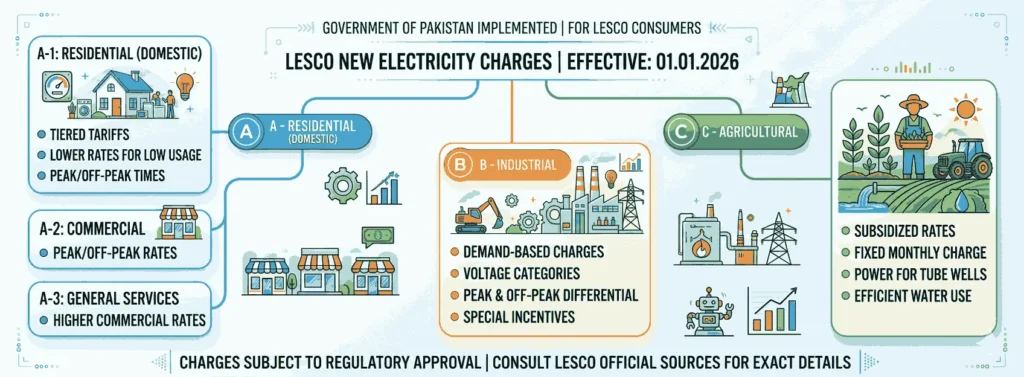
Furthermore, there are two types of charges: fixed and variable charges. All of the prices given below are in Rs. / kWh. Let’s explore!
A – Residential:
The first category is residential, which can further be divided into three sub-categories. Three sub-categories are domestic, commercial, and general services. You can check your LESCO bill here for any category by entering your reference number.
A-1 Residential (Domestic):
Have a look at the table below for unit prices for each consumption slab of the sub-category of domestic. You can apply for a new connection here.
|
Units Consumed / Month |
Units Consumed / Month |
Fixed Price (Rs. / Month) |
Variable Price (Rs. / kWh) |
|---|---|---|---|
|
1 |
Up to 50 Units |
– |
3.95 |
|
2 |
51 – 100 Units (Lifeline) |
– |
7.74 |
|
3 |
1 – 100 Units (Protected) |
– |
10.54 |
|
4 |
101 – 200 Units (Protected) |
– |
13.01 |
|
5 |
1 – 100 Units |
– |
22.44 |
|
6 |
101 – 200 Units |
– |
28.91 |
|
7 |
201 – 300 Units |
– |
33.10 |
|
8 |
301 – 400 Units |
200 |
37.99 |
|
9 |
401 – 500 Units |
400 |
40.20 |
|
10 |
501 – 600 Units |
600 |
41.62 |
|
11 |
601 – 700 Units |
800 |
42.76 |
|
12 |
Above 700 Units |
1000 |
47.69 |
|
13 |
Time of Use ToU (Peak hours) |
1000 |
46.85 |
|
14 |
Time of Use ToU (Off-Peak hours) |
– |
40.53 |
|
15 |
E-1 Temporary Residential |
2000 |
57.94 |
A-2 Commercial:
Commercial is the category where electricity is used for commercial purposes, for example, shops, small businesses, and offices, etc. The tariffs for this category are as follows:
|
Units Consumed / Month |
Units Consumed / Month |
Fixed Price (Rs. / Month) |
Variable Price (Rs. / kWh) |
|---|---|---|---|
|
1 |
Sanctioned load less than 5 kW |
1000 |
37.44 |
|
2 |
Sanctioned load 5kW and above |
1250 |
39.76 |
|
3 |
Time of use, Peak hours |
– |
43.82 |
|
4 |
Time of use, Off-Peak hours |
1250 |
35.15 |
|
5 |
E-1 Temporary Commercial |
5000 |
53.44 |
|
6 |
Electric Vehicle charging station (EVCS) |
– |
23.57 |
A-3 General Services:
Government schools, public infrastructure, community services, and street lights come under the general services. For this kind of service, the variable charges will be 42.48 Rs./kWh, and the fixed charges will be 1000 Rs./kW/M (1000 Rs. per kilowatt per month).
B-Industrial:
Operations involved in the manufacturing, fabrication, and physical transformation of goods/materials come under the industrial category. The tariffs for this category are as follows:
|
Tariff Category |
Voltage / Size |
Fixed Charges (Rs./kWh/M) |
Variable Charges (Rs./kWh) |
|---|---|---|---|
|
B-1 |
< 5kW / 25kW (400/230V) |
1000 |
30.38 |
|
B-1 Time of Use |
Peak hours |
1000 |
36.74 |
|
B-1 Time of Use |
Off-Peak hours |
– |
30.05 |
|
B-2 |
5-500kW / 25-500kW (400V) |
1250 |
30.73 |
|
B-2 Time of Use |
Peak hours |
– |
36.68 |
|
B-2 Time of Use |
Off-Peak hours |
1250 |
27.41 |
|
B-3 |
All loads up to 5000 kW (11,33 kV) |
1250 |
31.00 |
|
B-3 Time of Use |
Peak hours |
– |
36.68 |
|
B-3 Time of Use |
Off-Peak hours |
1250 |
28.24 |
|
B-4 |
All loads (66,132kV & above) |
1250 |
30.43 |
|
B-4 Time of Use |
Peak hours |
– |
36.68 |
|
B-4 Time of Use |
Off-Peak hours |
1250 |
27.96 |
|
B-5 |
All loads (220kV & above) |
– |
36.68 |
|
B-5 Time of Use |
Peak hours |
1250 |
23.13 |
|
B-5 Time of Use |
Off-Peak hours |
5000 |
42.25 |
|
E-2 Temporary Industrial |
– |
5000 |
42.25 |
C – Agricultural:
Agricultural activities and operations related to electricity come under this section. For example, tubewells, electrical turbines, irrigation systems, and other farming operations. For this category, LESCO has announced single variable and fixed charges. In the year 2026, due to government subsidy programs for domestic and agricultural consumers, the tariff rates are lower than the previous year. It can further be divided into three types:
C-1 (a)
SARP Tubwells
C-1 (b)
Agricultural Tubwells
C-1 (a)
3.5 kW to < 5 kW
C-1 (a)
5 kW and above
Have a look at the table below for the latest prices.
|
Sr No. |
Tariff Category |
Fixed Charges (Rs./kW/M) |
Variable Charges (Rs./kWh) |
|---|---|---|---|
|
1 |
C-1 (a) SCARP |
400 |
28.90 |
|
2 |
C-1 (b) Agriculture Tubewells |
400 |
28.90 |
|
3 |
C-2 (a) (3.5 kW to <5kW) |
400 |
34.71 (Off-Peak) / 42.78 (Peak) |
|
4 |
C-2 (b) (5kW and above) |
400 |
38.69 (Off-Peak) / 29.14 (Peak) |
Other Categories:
There are some other specialized categories that do not fit the domestic, commercial, and agricultural categories. There are no tariff slabs with respect to the consumption of electricity for these categories, which means tariff rates are fixed. A brief explanation is given below.
D – Residential Colonies:
Electricity supplied to governmental housing colonies (Pakistan Railways colony and WAPDA housing colonies, etc.) comes under this category.
E – Seasonal Supply:
This is one of the industries or operations that do not run throughout the year. For example, sugarcane crushing for sugar production, and ice factories (karkhana).
F – Bulk Supply (Residential):
Let’s say a private residential housing society’s owner buys electricity, in bulk, on one meter, from LESCO and then distributes it to individual houses. This comes under the bulk supply category.
G – Public Lighting:
Electric lights for public places, street lights, highway lights, and park lights come under this category.
H – Event-Based:
A temporary electrical connection for some specific event, political rallies, weddings, or exhibitions falls in this section.
Factors Involved in LESCO Tariffs Calculation:
LESCO bill calculation depends upon the following factors.
Peak and Off-Peak Hours:
LESCO has categorized the time of electricity usage into two categories (Peak hours and off-peak hours). Now these hours are not fixed; they vary from season to season. Specific timings for each season are given below.
|
Seasons |
Month |
Peak Hours |
Off-Peak Hours |
|---|---|---|---|
|
Winter |
December – February |
5 PM – 9 PM |
9 PM – 5 PM (Next Day) |
|
Spring |
March – May |
6 PM – 10 PM |
10 PM – 6 PM (Next Day) |
|
Summer |
June – August |
7 PM – 11 PM |
11 PM – 7 PM (Next Day) |
|
Autnm |
September – November |
6 PM – 10 PM |
10 PM – 6 PM (Next Day) |
Final Words:
LESCO has implemented the tariffs for its consumers, according to NEPRA’s national uniform tariff structure. Keeping the tariff rates, connection type, units consumed, and timing of use in mind, consumers can calculate their bill and plan their consumption in the future, and hence they can control or manage their electrical expenses.